
Every email has a cost. We help you pay less of it.
Your inbox quietly burns energy in data centers around the world. MailSweeper auto-deletes the emails you’ll never read again, shrinking your storage, your costs, and your carbon footprint.
The Numbers
Email looks free. It isn’t.
Every message you keep lives on a hard drive somewhere, powered around the clock and cooled by water or air conditioning. Multiply that by a few billion people.
0.3g
CO₂ per average email
Up to 50g with attachments
121
Emails received per person, per day
Most go unread
4.2B
Email users worldwide
347 billion emails sent daily
150M
Tonnes of CO₂ from email each year
≈0.3% of the world’s footprint
Sources: Mike Berners-Lee, “How Bad Are Bananas?” · Radicati Group · International Energy Agency
Why it matters
Spam filters can’t fix this. Your habits can.
Spam is easy, and it gets caught. The real pollution is the half-read newsletters, long-forgotten receipts, and expired promotions that sit in your inbox for years drawing power 24/7.
Most of email’s footprint comes from manufacturing devices and powering the data centers and networks that keep your messages online. Each email is tiny, but with 4.2 billion users sending 347 billion messages a day, it adds up to roughly 150 million tonnes of CO₂ a year.
Deleting what you’ll never read again is the single highest-leverage thing you can do. We built MailSweeper so you don’t have to remember to.
Where your email lives
Always-on power
Servers run 24/7 whether you read the email or not.
Cooling overhead
Data centers use millions of gallons of water to stay cool.
Network energy
Every sync and search burns power on the way to your device.
What it adds up to
Small clicks. Real-world equivalents.
Hard to picture grams of CO₂. Easier to picture this.
1,000 emails deleted
≈ 1 km not driven
Roughly 300g of CO₂, the equivalent of a short car trip.
10,000 emails deleted
≈ 7 days of an LED bulb
About 3 kg of CO₂. Small per email, big across thousands.
1 GB of inbox cleared
≈ 4 trees worth of CO₂
A full year of carbon capture, recovered from your trash folder.
How MailSweeper helps
Set it once. Track your impact forever.
AI knows what to keep
Receipts, important threads, and starred messages stay. The forgettable stuff goes.
Real-time carbon savings
Watch your footprint drop as MailSweeper clears emails on a schedule you control.
Storage you can see
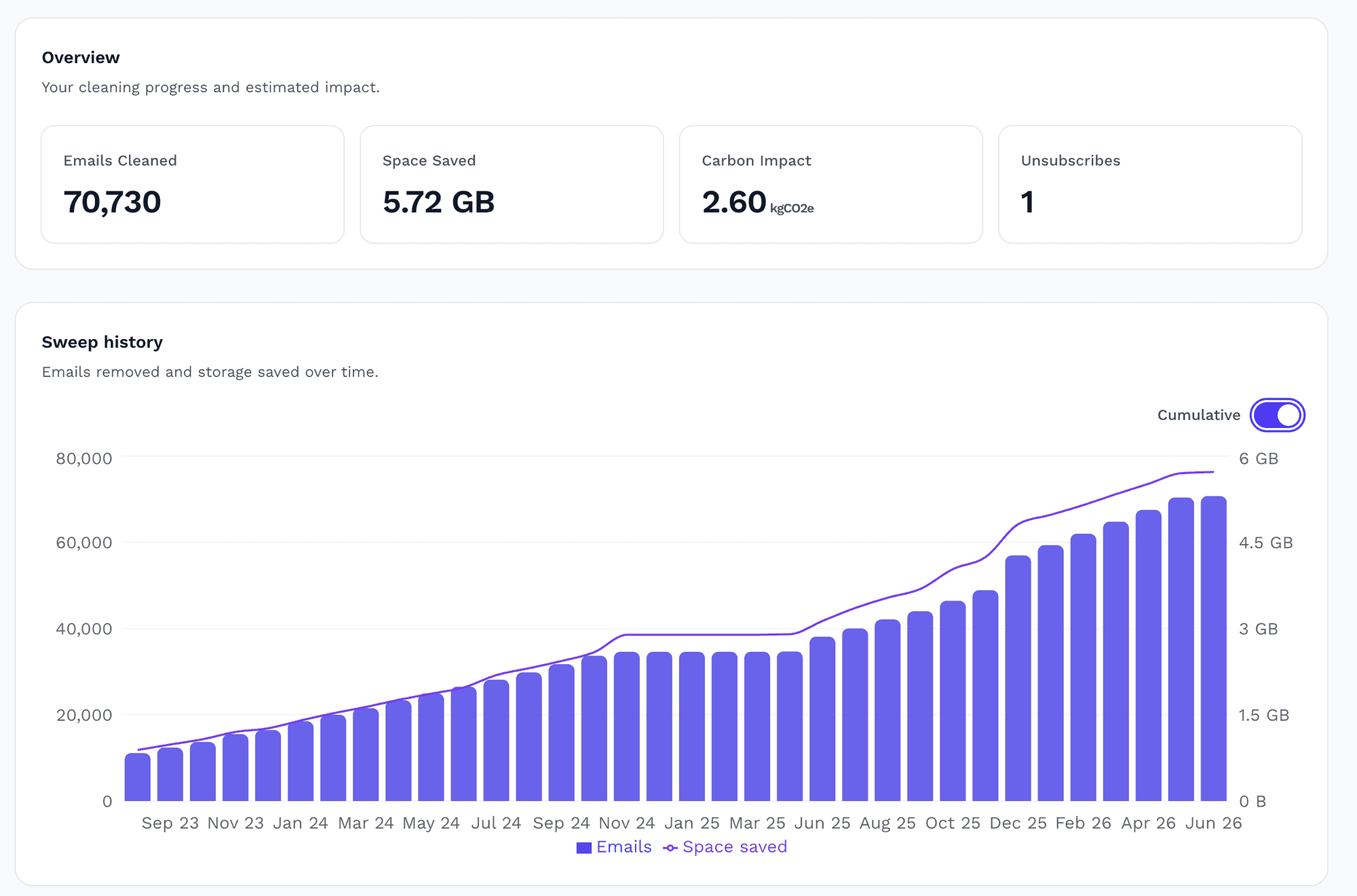
A dashboard of how many emails were swept and how much space you’ve reclaimed.
Privacy-first
We never read, store, or sell your email contents. CASA-certified.
We put 1% of revenue into carbon removal.
Cleaning up emails is the start. Through Stripe Climate, a portion of every MailSweeper subscription directly funds the next generation of carbon removal technology, from direct air capture to mineralization.
Common questions
The cost of email, explained.
How does email actually create carbon emissions?
Every email you keep is stored in a data center. Those data centers run 24/7, drawing power, consuming water for cooling, and running air conditioning to stay operational. Multiply that across billions of users and it adds up fast.
Don’t spam filters already handle this?
Spam filters catch the obvious junk. They don’t touch the half-read newsletters, expired coupons, and old shipping notifications that pile up year after year. That’s where most of the waste lives.
Aren’t data centers already powered by renewables?
Some are, but renewable capacity is finite. Every watt used to store a forgotten email is a watt that could power a home, a hospital, or another use that actually matters.
How much of a difference does deleting really make?
A single email is small, fractions of a gram of CO₂. But over a year, the average user could prevent kilograms of emissions by clearing what they’ll never read. At scale, that becomes meaningful.
Will MailSweeper delete emails I actually want?
No. Starred, important, and primary-inbox emails are always protected. You choose exactly which categories (Promotions, Updates, Social) get swept.
What does the 1% to Stripe Climate fund?
Stripe Climate pools contributions and funds frontier carbon removal companies like direct air capture, mineralization, and enhanced weathering, that actually pull CO₂ back out of the atmosphere.
Ready when you are
Clean your inbox. Lighten the planet.
Set it once. MailSweeper runs quietly in the background, saving storage, money, and a little carbon every week.
Lifetime or annual
Connect Google and sweep your inbox in under a minute.
Lifetime or annual. See pricing
